Mare in Heat Again After 15 Days
Preparing your mare for breeding season
Is your mare ready?
Information technology'south of import to breed your mare when she'due south in her best physical status.
When evaluating your mare'south status consider:
- Is she having regular heat cycles?
- Does she take a uterine infection?
- Is her body condition ideal?
- Is she upward-to-appointment on vaccines, dewormers and preventative dental work?
Regular heat cycles and supplemental lighting
Increasing your mare'due south exposure to daylight 2 to ii.5 months prior to breeding can ensure regular heat cycles and ovulation.
- To breed in February, first supplemental lighting in late November or early on December.
- Mares non previously exposed to supplemental lighting may take a longer time to cycle naturally.
- For a March or April foal, lighting can begin as early as January considering some mares won't naturally bicycle until early May.
Guidelines to supplemental lighting
- Add together supplemental lighting in the evening and in the winter until 11 p.g.
- Provide 16 hours of continuous lighting daily.
- Use a 200-watt incandescent seedling or two 40-watt fluorescent tubes; y'all should exist able to comfortably read a paper anywhere in the stall.
- Expose pregnant mares, due early in the season, to lighting as they may terminate cycling following their foal heat.
Rule out infections
Many stud farms require a uterine civilisation (pre-breeding swab) on open mares to rule out infection. Uterine cultures tin can too benefit the mare possessor by identifying undiagnosed infection. Infections can waste material several estrus cycles.
Occasionally, maiden windsucking mares will have an infection. For more than data on windsucking and other unwanted behaviors see unwanted behaviors and vices in horses. A complete veterinarian exam of the reproductive tract tin cheque these mares for injuries and structural defects that affect fertility and cycling. Arid mares probable underwent examination at the end of the previous flavour and are ready for a recheck.
Torso condition
We recommend breeding your mare when she's in moderate torso condition (torso condition score of 5 to 6) and calculation just a little weight. Mares in moderate to practiced condition are more probable to cycle and conceive than mares that are too thin or grossly overweight. Managing your mare's nutrition can assistance y'all plant the ideal body condition. Learn more about body condition scoring.
Breeding emergencies
Brand sure you have prepared for whatever convenance emergencies that may occur, peculiarly during natural cover. During breeding, contact your veterinary right away if the stallion has:
- Blood on the penis.
- Harm to the penis.
- A swollen scrotum.
- Colic.
While you wait, safely:
- Try to locate the drain source, check both the mare and stallion.
- Take the vital signs you're comfortable with on both horses.
- If the penis is out, utilise cold water using a hose.
Care of the broodmare
At present that your mare is significant, the goal is to keep her healthy through pregnancy so deliver a normal, healthy foal.
Biosecurity tips
- Keep mares in small groups with others at a like stage of pregnancy.
- Divide long-term resident mares of the farm from exterior mares.
- Isolate pregnant mares from horses probable to shed illness (e.thou. show horses, weanlings, etc.).
- Isolate pregnant mares from recently bred mares.
- Isolate pregnant mares using separate barns.
- Don't share water or feed sources.
Pregnancy exams and normal loss rates
Days 14 to 16: kickoff pregnancy test
- Ultrasound performed.
- Twin pregnancy corrected.
- Rebreeding planned if the mare isn't pregnant.
- Mares have a 6 percent chance of aborting by twenty-four hour period 40.
Days 24 to 25: Pregnancy Exam (occasionally done)
- Embryonic heartbeat establish
Days 30 to 35: Second pregnancy exam
- Confirms the mare is still pregnant.
- You lot tin rebreed the mare successfully if abortion occurs before this fourth dimension.
- You lot can't rebreed the mare if abortion occurs following 35 days; she will be infertile for three to 4 months due to endometrial loving cup germination in the uterus.
- Mares accept an 8 per centum take a chance of aborting subsequently twenty-four hour period 40.
- Older mares (20 years old) have an 21 percent chance of aborting at twenty-four hours 40, and 15 percent after day 40.
During pregnancy
Feed your mare to maintain moderate to good body status throughout pregnancy and lactation. You can expect your mare to proceeds 9 to 12 percentage of her torso weight during pregnancy. The mare will gain two-thirds of this weight in the final three months when the majority of fetus growth occurs.
During the start eight months of pregnancy, a mare'south nutritional requirements remain the aforementioned every bit when she conceived. In the last trimester, the mare'due south requirements increment faster than her demand for energy so you will need to supplement her diet for the following:
- Poly peptide (requirement: eight percent in early pregnancy, 11 to 12 percent in tardily pregnancy)
- Calcium
- Sugars
- Phosphorus
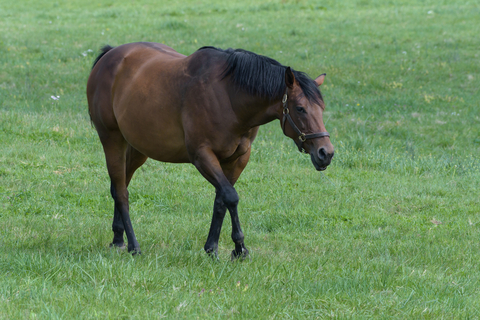
Free access to high quality, immature grass or alfalfa will usually meet the mare's energy and protein requirements. Simply neither of these forages will see her increased demand for phosphorus. Grass forages will also be too low in calcium. To correct this, mares should receive a daily salt-calcium-phosphorus mineral mix supplement. You tin can purchase supplements specific to the type of forage you lot feed.
Supplement with vitamins and trace minerals for fetal development. Copper, zinc, manganese, and iron are stored in the fetal liver. Enquiry shows mares that did non go a copper supplement in the final trimester had less audio foals than mares that did become copper. Feeding supplemental copper to the nursing foals didn't correct the problems.
Give mares natural vitamin E daily, thirty days before foaling, to increase the passive transfer of antibodies from mare to foal.
During lactation
Once lactation starts, the mare's energy and protein needs increase further. High quality forage with a mineral supplement can meet these needs, just about mares should also receive a grain/protein mix. You tin feed these mixes around 0.5 to 1 pound per 100 pounds of body weight daily.
Almost mares are re-bred around this fourth dimension, and fertility is best when the mare maintains status. After 3 months of lactation, a mare's milk production declines. You should offset slowly decreasing her grain before weaning to assistance her dry up.
Almost mares benefit from exercise during pregnancy. Many owners employ their mares for rigorous able-bodied competition (including racing and jumping) up to five months with no bug. You tin can proceed low-cal trail riding until the showtime of the last month of pregnancy. You may need to detect a saddle that matches her new shape. We recommend you turn out mares for at least vi hours per day if you aren't riding them.
Deworming
Most dewormers are safe for employ in pregnant mares, but e'er carefully read the label. Pregnant mares generally remain on the same deworming schedule every bit other mature horses. Many owners normally requite their mares a dose of ivermectin on the day of birth to aid prevent manual of worms to the foal.
We vaccinate broodmares for several reasons:
- To protect the mare from disease.
- To prevent abortion.
- To protect the foal by passive transfer of immunity through colostrum.
Vaccinations
Don't requite your mare vaccines in the kickoff sixty days of pregnancy. Ideally mares have completed their chief class of vaccination before pregnancy. Vaccinating mares in the last 3 to vi weeks of pregnancy ensures maximal protection of the newborn foal.
In Minnesota, vaccinate your broodmare against the following:
- Tetanus.
- Equine Canker Virus-one (EHV-1).
- Eastern and Western Encephalomyelitis (EEE + WEE, sleeping sickness).
- West Nile Virus (WNV) (late summer booster).
Fortunately, the concluding month of pregnancy usually lines up with the best time to give spring boosters for EEE, WEE and WNV.
Other diseases to vaccinate broodmares against:
- Flu
- HV-4
- Herpes virus abortion
- Rabies
- Strangles
- Rotavirus
- Potomac horse fever
Your vet can advise yous on which are best for your situation and when they are best administered. Due to the number of diseases involved, your veterinary may recommend splitting up the pre-foaling vaccines, giving half half-dozen weeks and half three weeks before the foal is due.
Consider the following when transporting your broodmare
-
How far along in pregnancy your mare is.
- Reliability of the vehicle and person trailering your mare.
- How well the mare travels.
- Weather condition.
Guidelines for trailering your broodmare
- Clean and disinfect the trailer between trips.
- Check the trailer for proficient ventilation.
- Make sure the trailer has skillful shock absorption.
- Bulldoze smoothly.
- Programme a route and time that avoids heavy traffic.
- Provide absorptive bedding, water, and hay for longer trips.
- Haulers schedule to stop every five to eight hours.
Research shows that send (nine hours in moderate temperatures) doesn't increase the miscarriage rate for mares in early on pregnancy (16 to 38 days). In late pregnancy, you should complete long-distance transport at least 30 days before the foal is due. Ensure your mare is at her foaling site four to six weeks earlier her due date. Mares demand fourth dimension to settle and develop immunity to local organisms.
Foaling
Signs of approaching foaling
The length of a normal pregnancy is commonly 335 to 342 days, but occasionally tin can range from 315 to 400+ days.
Almost a month before foaling, many mares start to develop swelling depression forth their belly. Additionally, the udder slowly starts to enlarge and will rapidly grow two weeks earlier term. During early development, the udder remains firm.
A few days before foaling, the udder gradually softens and fills with fluid, which slowly changes in advent from watery, to thick colostrum. Colostrum is generally present 1 to 2 days earlier birth. The average mare produces about 2 ½ to 5 liters of colostrum.
Softening of the pelvic ligaments progresses and the mare's tail head may appear more than elevated. Wicks of dried mammary secretion (waxing) usually appear near one mean solar day before birth and in the concluding few hours some mares will drip milk.
Preparation for foaling
- Provide the mare an surface area to foal; grassy paddocks or well-bedded stalls piece of work well.
- Strip-out, disinfect, and re-bed foaling stall.
- Utilize bedding that is condom for the fall; we recommend clean harbinger considering in that location is less run a risk the foal will breathe information technology in.
- Accustom maiden mares to having their udder handled a few weeks before foaling.
- Launder your mare's vulva area, inner thighs, and udder when foaling is imminent; you could give her a whole-body bath.
- Wrap your mare's tail when foaling is imminent.
Things to have available during foaling:
- Telephone and numbers for your vet and a shut experienced neighbour.
- A clock or watch, notepad and pencil so you can keep rail of the timing (estimating time accurately during and later on a foaling tin can be tricky).
- One-time clean towels for drying off the foal.
- Disinfectant in a small cup to dip the navel (your vet can aid with an advisable solution).
- Bucket, soap, and warm water for make clean-up.
- Strong trash bag for the placenta.
- Plastic or safety gloves to keep your hands clean.
Monitoring the mare prior to foaling
Monitoring your mare can ensure yous're in that location for foaling. Aside from changes in her udder, appearance of milk, and waxing, you can also test the milk's calcium content. While non foolproof, this examination tin can give a reasonable approximate of when the mare may foal. Most mares foal late at night, and so milk tests taken in the evening give more authentic results.
Foaling monitors are available that will send a signal to a pager or phone. Once again, while not foolproof, these practise provide a expert estimate.
Foaling stages
We commonly divide foaling into iii stages.
Stage i: Pre-delivery
-
The mare's cervix gradually relaxes.
-
The mare'south uterus starts to contract, pushing the placenta, foal, and fluids against the cervix.
-
The mare's cervix dilates.
-
The mare's water breaks.
This procedure lasts 1 to 6 hours and may go unnoticed. Your mare may appear mildly colicky with signs including:
- Looking at her flank.
- Stretching out.
- Urinating and passing manure frequently.
- Lying down repeatedly.
- Dripping milk.
Phase ii: Delivery
The mare lies on her side. She may stand upwardly and lie down several times before you evangelize the caput. The mare actively strains, usually in series of 3 or iv followed by a short balance.
Within about ten minutes of her h2o breaking, a whitish translucent fluid-filled airship (the water bag or amnion) should announced.
Delivering the feet
- A pes will appear in the amnion. The soles of the feet should point to the mare's feet (i.due east. the foal is the same fashion up every bit the mare).
- Information technology is normal for the legs to protrude further as the mare strains and then slide dorsum in when she relaxes. This gradual move is important for proper dilation of the nativity canal.
- Don't immediately grab the legs and pull when they appear. Pulling can impairment the cervix and vagina and affect hereafter fertility.
Delivering the head
- The nose should appear next, lying on acme of the legs. Passage of the caput often takes a little longer in maiden mares as the vagina stretches over the poll. Allow fourth dimension for dilation to occur.
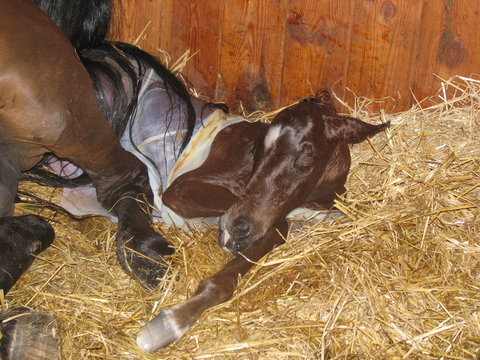
Delivering the chest
- The chest is the widest function of the foal. Equally the chest enters the birth canal, the mare often strains harder.
- The anxiety should remain one in front of the other rather than even. This minimizes the width of the shoulders, making them much easier for the mare to pass.
- Once the chest is out the rest of the foal usually passes hands, and the mare ofttimes stops straining.
- With normal, healthy foals the h2o bag ordinarily ruptures past the time the chest is passing so the foal can exhale. If it doesn't, tear it open and clear it abroad from the caput.
Leave the mare and foal alone unless the mare is kicking at the foal.
- The mare generally rolls onto her breast and stands within 15 minutes and the umbilical cord breaks one to two inches from the foal'southward abdomen.
Stage three: Passing the placenta
- Passage of the placenta occurs within 1 hour later the foal's birth.
- The mare may be slightly crampy while passing the placenta.
- Save the placenta then it can be checked for completeness and for any signs of infection.
When to call for help - signs of a problem
During foaling
The total time, from water suspension to the finish of delivery, usually takes about xx minutes. Occasionally this time may extend to an hour. Experience is the all-time guide to potential problems. Any time the mare isn't making reasonable progress, a trouble may be present. It'southward always better to telephone call for aid rather than to wait and see. Time is of the essence if nosotros are to get a normal foal.
Call your veterinarian immediately if:
- The amnion or a foot has non appeared in about x minutes after the water breaks.
- But 1 foot appears and isn't followed by the other.
- The feet are upside down.
- The nose appears get-go.
- I or both feet are over the top of the caput.
- A red bag appears.
- The mare made progress but stopped for more ten minutes.
- The mare colics later commitment.
While you look and if it'south condom:
- Wrap the mare'south tail.
- Clean the mare'south vulva with mild soap and water.
- Open the membranes if the foal is visible or if you come across a thick cerise sac.
- Go on the placenta, the mare should pass it within 3 hours.
Afterwards foaling
Call your veterinarian immediately if the foal,
- Has severe diarrhea.
- Is lethargic or depressed.
- Isn't sucking.
- Isn't continuing within 3 hours.
- Starts to nurse only seems to forget how.
- Has swollen joints.
- Is built-in greater than 1 week before its due date.
- Isn't allowed to nurse by its dam.
While you expect, milk out the mare if it'southward condom, and keep premature foals repose.
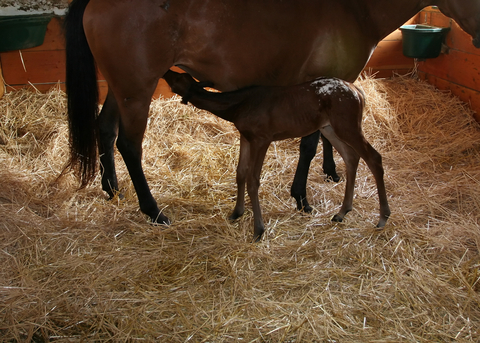
Caring for the newborn foal
Signs of a healthy foal include:
- A very active manner.
- Standing and nursing within two hours.
- Passing urine and orange-brown manure (meconium) within six hours.
When the umbilical string breaks, dip the navel stump in dilute chlorhexadine diacetate to forbid infection. Repeat this every viii hours for 48 hours.
The mare'due south first milk (colostrum) is very important for the foal. Information technology contains antibodies needed to ward off infection. If the mare leaks her colostrum, or if the foal fails to nurse well in the first 12 hours, information technology volition be at high take chances for life-threatening infections. Newborn foals can develop serious illness rapidly. Contact your veterinarian right abroad if the foal:
- Fails to stand and nurse soon after birth.
- Shows signs of depression.
- Doesn't nurse every bit much.
- Is dehydrated.
- Persistently strains to urinate or defecate.
Even if the birthing goes well and your foal appears healthy and normal, we strongly recommend a health check and blood test for antibody levels in the first 24 hours.
Reviewed in 2021
Source: https://extension.umn.edu/horse-health/caring-your-mare-during-breeding-and-foaling
0 Response to "Mare in Heat Again After 15 Days"
Post a Comment